Author: Gerson Camus

The Under One Sky Friendship Centre is one of the partners in the Our Health Counts study, along with Menahqesk Wellness Circle and the University of New Brunswick.

Gary Gould, a member of the Wolastoqiyik Nation, has been advocating for the rights of non-status Indigenous people who live outside of First Nation communities since the 1970s. “Hopefully, as a result of this data-based study, it’ll convince the policymakers that there needs to be special attention given to this community of Indigenous people,” Gould said.

The study is called Our Health Counts, and it’s being conducted by the University of New Brunswick, Under One Sky Friendship Centre in Fredericton and Menahqesk Wellness Circle in Saint John.

Neil Forbes, a PhD student at the University of New Brunswick and member of the Saddle Lake Cree Nation, is co-leading the study.

“Just trying to show the real numbers of how many urban Indigenous people are in New Brunswick, and what needs are not being met by us having a poor understanding of those numbers,” he said.

Forbes, who is also an assistant professor at the University of Prince Edward Island, hopes it will help to define the urban Indigenous community in Fredericton and eventually Saint John. “Basically, the more data we have the more helpful it will be for the community.”

The study, which was designed by Métis family physician Dr. Janet Smylie, has already been conducted in seven cities in Ontario and in Winnipeg.

In 2021, the results of the Our Health Counts study in Thunder Bay showed that the Indigenous population was two to four times higher than estimated by Statistics Canada.

Forbes expects the results will be similar in Fredericton and Saint John.

“The Indian Act is structured so that resources for Indigenous people are based on whether or not you live on-reserve,” he said.
“If all of these people are not getting the supports they need just because they’re off-reserve instead of on-reserve, it causes a real issue. And so, the more information we have, the better.”

Forbes said this is “a huge public health issue.”

Gould said participants are asked about what health conditions they have, whether they have experienced discrimination accessing health services and how services could be improved.

“We have to have clear proof,” he said. “Data that shows that, first of all, there’s a need and that there’s systemic problems for people accessing programs and services.”
Forbes said it is difficult for many urban Indigenous people to feel “culturally safe” accessing health services.

“The questions are all very much geared towards, ‘What is your experience as an urban Indigenous person in New Brunswick?’” he said, including questions about whether they speak an Indigenous language and their connection to traditional ceremonies and medicines.

The Thunder Bay study in 2021 showed that two out of five Indigenous adults feel that they didn’t receive the help they needed when it came to mental health and substance use. Less than 50 per cent of participants reported having good oral health.

Gould, who is also president of the board at Under One Sky, said the five-year study is in its second year and they are still looking for participants. Next year, researchers plan to expand to Saint John, where they will work with the Menahqesk Wellness Circle.

He hopes that the study will eventually lead to Indigenous people accessing health services “in a spirit of trust, respect and friendship.”


Logan Turner | CBC News | Posted: September 27, 2022 10:00 AM | Last Updated: September 27, 2022

Data fills gaps in urban Indigenous health information, offers recommendations on a way forward

Significant number of Indigenous people in Kenora, Ontario, experienced racism in past year, new study says

A new study has revealed that racism and other forms of discrimination are having significant, adverse effects on the health of Indigenous
people living in or near Kenora, Ont., a city of about 15,000 people located almost 500 kilometres west of Thunder Bay.

Three in five study participants reported they’d been treated poorly or unfairly because of their Indigenous identity, with 75 per cent of those respondents saying they’d experienced racism in the past year.

More broadly, 72 per cent of the participants reported they see racism to be a problem in the northwestern Ontario city.
“It validated what we already knew from our lived experience, such as the high rates of racism and discrimination people face, which can lead to misdiagnosis or delays in seeking treatment, the high numbers of mental health and trauma experienced,” said Serena Joseph, the executive director of Waasegiizhig Nanaandawe’iyewigamig (WNHAC), an Anishinaabe health agency serving the Kenora area and the community lead organization for the study.

The “Our Health Counts” community-based study — developed by Well Living House, a research centre focused on Indigenous health and well-being based in Toronto, and completed jointly with WNHAC — collected the life stories from 320 First Nations and Métis people aged 15 or older that were living or accessing services in Kenora. Participants were invited to take part in the survey using respondent-driven sampling methods.

“It also uncovered some things we didn’t know, [such as] the degree to which we were undercounted,” Joseph said, adding that one of the other significant findings is that the urban Indigenous population in or around Kenora is 2.6 to four times larger than what the 2016 census indicated.

While the 2016 census said there were 3,155 Indigenous people living in Kenora, the study estimates that the total Indigenous population living in the city is actually between 8,448 to 12,892.

Three in five Indigenous adults that participated in the Our Health Counts
study reported they'd been treated poorly or unfairly because of their
Indigenous identity.
(Logan Turner/CBC)

Three in five Indigenous adults that participated in the Our Health Counts study reported they’d been treated poorly or unfairly because of their Indigenous identity.
(Logan Turner/CBC)

This is the sixth community to have participated in the “Our Health Counts” study with Well Living House, all of which have demonstrated that Statistics Canada’s national census is systemically undercounting Indigenous people, said Dr. Janet Smylie, a Métis family physician, director of the Well Living House and the Canada Research Chair in advancing generative health services for Indigenous populations.
“It’s time to actually just acknowledge that First Nations, Inuit and Métis living in urban and related homelands actually are getting second rate information gathering. So the census is not working for them, and we need to look at other options,” she said.

Study reveals health inequities in Kenora

  • The information shared by the participants of the study will help organizations in the area better understand the health needs of the urban
    Indigenous population, and develop strategies to address the health inequities.

Other findings of the study include:

  • Poverty rates were almost five times higher among Indigenous adults than the general Kenora population, with 63 per cent living at
    or below the before-tax low-income cut-off.
  • Almost seven in 10 Indigenous adults have not completed high school.
  • Two in five participants reported speaking an Indigenous language, with 92 per cent reporting that speaking or learning a language
    was important.
  • One-third of Indigenous adults do not have a regular place to go for health advice or when they are sick.
  • About 40 per cent of Indigenous adults reported they had been treated unfairly by a health care professional because of their Indigenous identity, and 14 per cent reported avoiding health or social services due to discrimination.
  • Almost one in three Indigenous adults reporting racism said it affected their overall health and well-being.
  • Half of the study participants think there are inadequate mental health services, and nearly 40 per cent believe there are inadequate suicide prevention resources serving Indigenous people in Kenora.

While looking at the data, Smylie said she’s amazed by the resiliency and close family relationships of Indigenous people in the region, adding that 55 per cent of respondents feel happy and are interested in life every day or almost every day.
“I’m just constantly inspired and astounded by the way that First Nations, Inuit and Métis people are able to find meaning in life, are able to keep up good spirits, even though there’s these huge challenges that are happening, which include day-to-day experiences of racism and gaps in access to mental healthcare,” she said.

Data must be used to inform policy
While this information is important, Joseph added, it must now be acted upon with new funding and services designed to address the social and health inequities that exist in the region. Those programs need to be created and led by Indigenous people, and funded by all levels of government, she said.

“Although we face a lot of challenges in terms of racism, discrimination and mental health as a result of the long-standing impact of colonialism, there is that great desire and connection to culture as well as healing and treatment,” Joseph said.

But Smylie said non-Indigenous people — especially healthcare providers — also have to put in the work.
“People are dying because of this culturally unsafe care. It’s not acceptable. So please sign up and take Indigenous cultural safety
training,” she urged healthcare workers.

“We need to have zero per cent Indigenous people experiencing culturally unsafe care.”


Logan Turner | CBC News | Posted: September 27, 2022 6:00 AM | Last Updated: September 27, 2022
Data fills gaps in urban Indigenous health information, offers recommendations on a way forward


National Association of Friendship Centres Calls for Budget 2026 to Be a Turning Point for Urban Indigenous Communities

Source: https://www.theglobeandmail.com/investing/markets/markets-news/GlobeNewswire/4515899/national-association-of-friendship-centres-calls-for-budget-2026-to-be-a-turning-point-for-urban-indigenous-communities/


OTTAWA, Ontario, Sept. 09, 2026 (GLOBE NEWSWIRE) — The National Association of Friendship Centres (NAFC) is calling on the Government of Canada to make Budget 2026 a transformative moment for urban Indigenous communities by building on recent federal investments and scaling support through the Friendship Centre network.

In a letter submitted to the Honourable François-Philippe Champagne, Minister of Finance, the NAFC welcomed the federal government’s recent commitment of $168 million over five years through Indigenous Services Canada. This funding represents an important step toward stabilizing the operational foundation of Friendship Centres and recognizing their essential role in delivering culturally grounded services to Indigenous Peoples living in urban areas.

“Friendship Centres are one of the most effective Indigenous service delivery networks in the country,” said Pam Glode-Desrochers, President of the NAFC. “With over 100 Friendship Centres serving nearly one million people each year, we are on the front lines, supporting not only Indigenous communities but anyone who comes through our doors seeking help. Budget 2026 is an opportunity to build on this momentum and invest where it will have the greatest impact.”

As nearly 80% of Indigenous Peoples in Canada now live in urban communities, the NAFC is urging the federal government to take a targeted approach to new investments by working through the Friendship Centre network. The NAFC’s recommendations focus on expanding support across key federal priorities, including housing and infrastructure, employment and skills development, gender-based violence prevention, emergency response and preparedness, and Indigenous-led artificial intelligence and data capacity.

“Friendship Centres deliver more than social services, they provide the foundation for workforce participation and community wellbeing,” said Jennifer Rankin, Chief Executive Officer of the NAFC. “Investing through our network is a proven, cost-effective way to reduce barriers to employment, improve labour force participation, and lower downstream costs in healthcare, justice, and emergency systems.”

The NAFC is specifically calling for the creation of dedicated Friendship Centre delivery streams within federal housing, infrastructure, and employment programming, sustained multi-year investments to address gender-based violence and support survivors, permanent funding to recognize the role of Friendship Centres in emergency response including during wildfire evacuations, and targeted investments in Indigenous-led digital infrastructure to support data sovereignty and modernize service delivery.

Friendship Centres continue to play a critical role in supporting communities during times of crisis, often stepping in to deliver essential services that are otherwise underfunded. By directing investments through this established, Indigenous-led network, the federal government has an opportunity to deliver measurable outcomes that advance economic participation, public safety, and reconciliation.

The NAFC looks forward to working in partnership with the federal government to ensure Budget 2026 delivers meaningful and lasting impacts for urban Indigenous Peoples across Canada.

For media inquiries
John Paillé
Senior Communications Coordinator
jpaille@nafc.ca

About the National Association of Friendship Centres
For more than 50 years, the National Association of Friendship Centres (NAFC) has supported a network of over 100 Friendship Centres across Canada, delivering culturally relevant services to urban Indigenous communities. Friendship Centres support nearly one million Indigenous people each year through more than 3,000 programs, providing essential services including employment and training, childcare, health supports, housing, and cultural programming. With more than 4,300 staff and 12,000 volunteers, Friendship Centres are among the most significant Indigenous service delivery networks in the country.

Indigenous leaders call for change in Sask. health care after woman’s death during childbirth

Indigenous leaders call for change in Sask. health care after woman’s death during childbirth

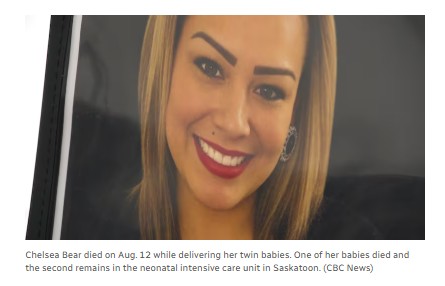
Chelsea Bear’s family says she was sent home from hospital without proper care

Source: Hannah Spray · CBC News · Posted: Sep 22, 2026 7:28 PM EDT | Last Updated: September 22


WARNING: This story contains details about death in childbirth.

First Nations leaders say a declining health-care system and systemic racism within that system both contributed to a mother’s death from complications during the birth of her twins.

“No matter where you are in life, you should have fair and equitable treatment. Everybody should be treated the same,” Meadow Lake Tribal Council vice-chief Richard Derocher said on Tuesday, speaking alongside the family of Chelsea Bear at a news conference in Saskatoon.

Bear, a member of Flying Dust First Nation, went to hospital on Aug. 10 in Meadow Lake, in pain and bleeding, but was sent home without receiving proper care, her family said. She was 36 weeks pregnant and her pregnancy was considered high-risk.

The next day, the pain and bleeding increased severely, and Bear returned to the hospital. She was ultimately taken to Saskatoon, where the first twin was delivered stillborn and the second baby was born very weak, her family said.

Bear died after their deliveries, in the early hours of Aug. 12. She was 36 years old and left behind four other children, in addition to the surviving twin, Gracie, who is still in the neonatal intensive care unit in Saskatoon.

Her family said she died from hemorrhaging blood due to placental abruption — which is when the placenta separates too early from the uterus.

They said that if Bear would have received proper care when she first went to hospital, she and both her babies would still be alive.

“She must have been so scared, I was thinking, just losing all the blood.… It must have hurt her,” Chelsea’s mother Deb Bear said at a news conference Tuesday in Saskatoon.

“I just don’t want this ever to happen to anybody else.”

Bear’s family is the second Indigenous family to speak out and call for change after the death of a mother during childbirth in Saskatchewan this year.

Jaali Sutherland-Weenie, from Beardy’s & Okemasis Cree Nation, died on April 26 after first going to the hospital in Rosthern with severe back pain and vomiting, then being sent to Saskatoon. Her family said she was diagnosed with pre-eclampsia, a blood pressure condition. Her baby girl survived.

Sutherland-Weenie’s family said they believed she would have been treated differently if she were not Indigenous.

Systemic racism alleged

On Tuesday, near the end of a lengthy news conference, Derocher said that speaking about Bear’s death is complicated “because of all the things that are not being said” when people are “trying to be as nice as possible.”

He and Meadow Lake Tribal Council Tribal Chief Jeremy Norman both said they were on a conference call with representatives of the Saskatchewan Health Authority that took place after MLTC reached out to them about Bear’s death.

They said they expressed frustration that they weren’t getting answers and told the SHA they were considering holding a news conference.

Norman said an SHA representative “basically told us, keep quiet, because it’s so hard to get doctors in our region, it’s so hard to get people to come and work in the north.”

Derocher said those words “burnt me hard,” and are another example of the systemic racism that happens every day, when First Nations people are asked “to keep silent, do not speak of this issue, do not bring it forth.”

He and the other chiefs also spoke about how they have seen the quality of health care declining for everyone in Saskatchewan over the past two decades — in everything from hospital care to long-term care — and how they want to work with the province to make positive changes.

SHA to conduct patient safety review

The SHA declined an interview request, but issued a statement extending their condolences to the family and community for the “profound and tragic loss.”

The statement didn’t directly answer a question about Norman and Derocher’s account of the conference call where they said they were asked to keep quiet. The statement said the SHA met with the MLTC to hear their concerns, but at the time of the meeting, “the SHA had not received consent from the family to discuss the specifics of their case with MLTC.”

“We have since received the family’s consent and will continue our discussions with MLTC in the coming days,” the SHA’s statement said.

The health authority said it would be conducting a thorough patient safety review.

“The SHA acknowledges the complex and dynamic conditions that our maternal health and obstetrical clinical teams operate within, and appreciate their commitment, clinical expertise and professionalism.”

Independent investigation called for

The MLTC chiefs and Flying Dust First Nation Chief Tyson Bear are calling for more than a patient safety review.

“We are calling for a thorough, independent, transparent investigation, so Chelsea’s family can get the answers they deserve,” Chief Bear said.

Chelsea Bear’s death was not an isolated incident in the health-care system, the chiefs said.

In a news release, they highlighted that it is the sixth quality-of-care incident that the Meadow Lake Tribal Council has tried to raise with the SHA this year.

“We’re here for a better health system. We’re here to make change,” Tribal Chief Norman said.

“It’s unfortunate things like this have to happen before we look at making change, before we really dig in to say, ‘What’s the problem?'”

Nishnawbe Aski Nation (NAN) blames Ottawa for death of Fort Severn First Nations woman (SLFNHA) re Miranda Mamakwa.

Miranda Mamakwa missed four appointments following open-heart surgery, and claimed prior to her death that the Non-Insured Health Benefits program failed to provide for her transport.

The Sioux Lookout First Nations Health Authority (SLFNHA) and the Nishnawbe Aski Nation (NAN) are demanding “immediate, public accountability” and an independent investigation into the death of Fort Severn First Nation member Miranda Mamakwa.

Mamakwa died on Sept. 8. According to a press release by the SLFNHA and NAN, she had open-heart surgery on April 23 and was supposed to have had follow-up appointments “mandatory for her recovery and survival” on May 28, June 11, July 2 and Aug. 6.

SLFNHA and NAN say in their statement the federal Non-Insured Health Benefits program (NIHB), for First Nations and Inuit to access medical care not available in their communities, failed to arrange travel and accommodations, making it impossible for Mamakwa to reach her appointments and receive treatment.

Fort Severn is located in the extreme north of Ontario on Hudson Bay, near the Manitoba border.

Last weekend, Mamakwa was taken to the Fort Severn First Nation nursing station and transported to Thunder Bay Regional Health Sciences Centre, where on Tuesday her family removed her from life support.

Nearly a month earlier, on Aug. 19, Mamakwa made a Facebook post listing the four appointments she said she had missed because NIHB had failed to arrange travel.

She closed by saying, “If I die, please go after them.”

“Those words,” the statement from SLFNHA and NAN reads, “are now a demand SLFNHA and NAN intend to see answered.”

In their statement, SLFNHA and NAN say they’ve warned for years that delays and bureaucratic failures in the NIHB program were risking the lives of people in Kiiwetinoong and across NAN territory.

“From cancelled medical travel to appointments booked, and missed, with little or no notice,” the statement reads. “Miranda Mamakwa’s death is the clearest and most devastating proof yet that these were not exaggerated warnings.”

NAN Grand Chief Alvin Fiddler said, “It is outrageous that Miranda’s travel was denied on four separate occasions. There is no doubt in my mind that her life may have been saved if she had been allowed to travel to her appointments. The circumstances around her passing are extremely troubling and the denial of travel by NIHB demands accountability.”

Fiddler argued those in charge of NIHB must understand medical transportation as a matter of life and death, rather than a simple issue of paperwork.

“The officials responsible should be asking themselves why our members are still subject to such a horrific bureaucracy that denies them access to life-saving care,” Fiddler said. “Days before she began her Spirit Journey, Miranda posted to social media that ‘If I die, please go after them.’ We will honour her dying wish by demanding full accountability.”

SLFNHA and NAN are insisting upon an immediate, independent investigation into Mamakwa’s death, including identifying which staff members and decisions prevented Mamakwa’s medical travel.

They’re also demanding a public accounting from Indigenous Services Canada of what went wrong and who was responsible for those circumstances, as well as a direct meeting between NAN/SFLNHA leadership and Indigenous Services Minister Mandy Gull-Masty.

Finally, SLFNHA and NAN say they want to see “concrete, funded fixes to the NIHB medical travel and appointment system for the 33 First Nations SLFNHA serves and the 49 First Nations of NAN before another family loses someone they love.”

“Miranda Mamakwa should still be here today, raising her three children,” said SFLNHA president and CEO Sonia Isaac-Mann. “Her death is not something that simply happened to her, it is the result of a system that failed her, appointment after appointment, for months. SLFNHA and NAN have raised these gaps for years, and we are done accepting apologies with no accountability behind them.”

APTN News reached out to Indigenous Services Canada for a comment regarding the allegations NIHB failed to provide travel for Mamakwa’s four appointments, or that its handling of Mamakwa’s case was responsible for her death. We have not received a statement.

APTN also reached out to the minister’s office. In a statement forwarded by her press secretary, Gull-Masty said she has “instructed Indigenous Services Canada officials to urgently establish the facts surrounding Miranda’s death and the circumstances that led to it.”

She also said she would be meeting with SLFNHA and NAN “at the earliest opportunity.”

“Miranda Mamakwa was a member of Fort Severn First Nation, part of a family, a community and a Nation that knew her, loved her and are now mourning her loss,” said Gull-Masty. “I want to acknowledge Miranda, the life she lived and the place she held in her community.

“My deepest condolences go to Miranda’s family, loved ones and the entire Fort Severn First Nation during this incredibly difficult time. They deserve answers about what happened.”

Mamakwa’s family reached out to APTN but were not available for an interview prior to this article being published.

If you or someone you know is in crisis, the Hope for Wellness Help Line offers immediate help to all Indigenous peoples across Canada at 1-855-242-3310 or connect to the online chat at www.hopeforwellness.ca.


Source: https://www.aptnnews.ca/national-news/nan-blames-ottawa-for-death-of-fort-severn-first-nations-woman-mamakwa/

The Canadian Medical Association has updated its code of ethics to clarify how doctors are expected to address racism and discrimination in health care.

OTTAWA — The Canadian Medical Association has updated its code of ethics to clarify how doctors are expected to address racism and discrimination in health care.

The CMA says the updates give physicians clearer guidance on providing culturally safe, trauma-informed and equitable care, respecting Indigenous knowledge and working with colleagues.

The reforms are part of the CMA’s reconciliation action plan and the code is now available online in four Indigenous languages: Anishinaabemowin, Michif, Northern Michif-Cree and Inuktitut.

We offer our heartfelt condolences to the families of those lost and wish a speedy recovery to the injured in this terrible event

Members of the Karihwáhstha team wishes to express our deep sorrow over the tragic event yesterday at Tumbler Ridge Secondary School, Tumbler Ridge, BC.

All life is a gift from the Creator, and when that gift is lost we all suffer a loss.

We offer our heartfelt condolences to the families of those lost and wish a speedy recovery to the injured in this terrible event.


A Tribute to Dr. Barry Lavallee from Karihwáhstha Team

A Tribute to Dr. Barry Lavallee from the Karihwáhstha Team

Those of us collaborating on the Karihwáhstha initiative are deeply saddened by the passing of renowned Indigenous physician and advocate Dr. Barry Lavallee, Chief Executive Officer of Keewatinohk Inniniw Minoayawin Inc.

Dr. Lavallee was a respected physician, visionary leader, and titan of patient advocacy whose tireless fight to decolonize Manitoba’s healthcare system leaves a legacy that well serves the next seven generations—and beyond.

Guided by principle, Dr. Lavallee confronted the uncomfortable realities of healthcare disparity. He challenged the systems that created inequity, truly speaking truth to power.

His bold questions and observations inspired us to enhance our own response to health system and community needs.

Dr. Lavallee received a Medal of Excellence from Doctors Manitoba in 2022—a recognition deeply reflective of his lifelong dedication to his patients and community. During the Covid crisis, Dr. Lavallee fearlessly advocated for the northern First Nations to have priority to vaccinations, ensuring those most vulnerable were protected.

A trusted voice and visionary leader, his absence will be profoundly felt across the healthcare system.

We extend our condolences to his colleagues and loved ones.

Elders tell us Dr. Lavallee is on a good journey.


We dedicate this work to him.

Karihwáhstha Team